



Pain Lives in the Myths: What Nobody Tells You About Back Pain (and What Actually Helps)

If you've been living with back pain for months or years, chances are you've heard some well-meaning advice that's left you more confused than reassured. "Your back is worn out." "You should avoid bending." "You'll just have to live with it." Unfortunately, many of the messages people receive about back pain are outdated, confusing or incomplete.
Over the past two decades, research has transformed our understanding of persistent back pain. It is really important to note that when we unpack these pain myths, we're not saying pain isn't real or that it's "all in your head." Persistent pain is always real. This blog explores what current evidence tells us—not to assign blame, but to offer another way of making sense of pain that may open new possibilities for recovery.
This article forms part of National Pain Week, an initiative by Chronic Pain Australia to raise awareness of the realities of living with persistent pain. As part of this year's campaign, MoreGoodDays partnered with BUPA and Chronic Pain Australia to explore some of the most common myths about back pain and what modern pain science tells us instead.
Myth 1: "My scan explains my pain."
One of the biggest misconceptions about back pain is that MRI or X-ray findings explain why you're hurting. When your scan has findings such as disc degeneration, disc bulge, herniated disc, or “wear and tear”, it's understandably frightening. These findings and how they are presented to you can seem as though your spine is damaged or wearing out.
But research tells a very different story.
Large studies examining spinal scans of people without back pain have found that age-related changes are incredibly common [1].
For example:
- Around 40% of people in their 20s have signs of disc degeneration.
- By the age of 50, this rises to approximately 80%.
- Disc bulges are also common in people who have no pain at all.
These findings are considered a normal part of aging, much like wrinkles on the skin or grey hair.
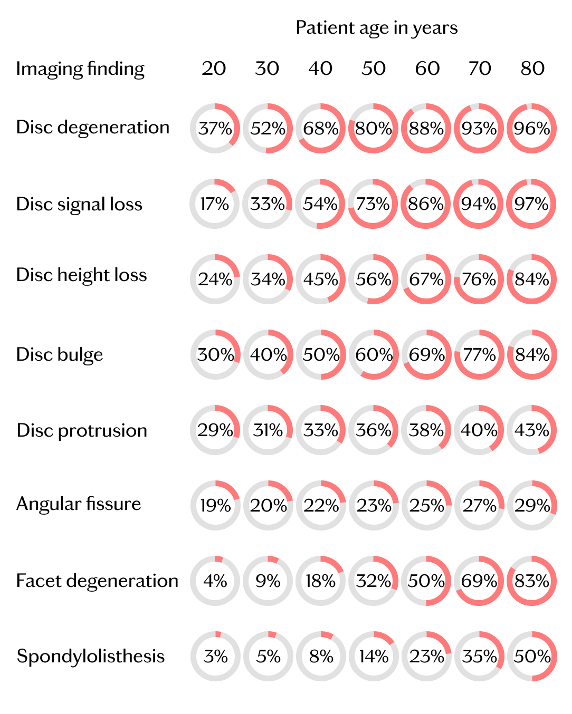
Source: Brinjikji, et al (2015).
A scan tells us about the structure of your spine, but structural findings alone often don't fully explain why someone is experiencing pain.
But if scans rarely tell the whole story, what does? Modern pain science shows that persistent pain is influenced by many factors working together. Previous injuries, the nervous system, stress, sleep, physical activity, emotions, beliefs about pain and even past experiences can all shape how much protection the brain thinks your body needs. In other words, pain is rarely explained by one structure alone—it's the result of a complex system designed to keep you protected.
Myth 2: "More pain means more damage."
It's logical to assume that more pain must mean more damage. In fact, this is one of the most common misunderstandings about persistent pain—and one of the hardest to challenge.
To help understand this, we need to understand the purpose of pain. Pain is your body's protection system. For example, when you touch a hot surface, your brain produces pain to encourage you to move away from danger. In this situation, pain is doing exactly what it is designed to do.
However, when pain becomes persistent, the nervous system can become overprotective.
A helpful way to think about this is like an amplifier.
Imagine an electric guitar.
You can make it louder by:
- hitting the strings harder
- or turning up the amplifier.
With persistent pain, the amplifier has been turned up. Small, everyday movements can suddenly feel very painful—not because damage is increasing, but because your nervous system has become more protective.
This is why one of the key principles of modern pain science [2] is:
Hurt doesn't always equal harm.
Pain is always real. But it doesn't always mean your body is being damaged.
When should you worry about back pain?
Most chronic back pain is not caused by a serious underlying condition. However, there are times when medical assessment is important. These are often referred to as red flags and you should seek urgent medical attention if you experience:
- sudden loss of bladder or bowel control
- numbness around the groin or saddle area
- significant weakness in one or both legs
- severe back pain following major trauma such as a car accident or serious fall.
You should also speak with your doctor if you have back pain alongside unexplained weight loss, fever, a history of cancer, pain that is severe at night, worsening numbness, tingling or weakness and/or prolonged morning stiffness lasting more than 30 minutes.
These situations are uncommon, but it's important to have them assessed.
Myth 3: "The best thing I can do is rest."
When pain strikes, avoiding movement feels like the safest option and this makes perfect sense after an acute injury.
But with persistent back pain, long-term rest can actually keep the pain cycle going.
Avoiding movement can lead to:
- reduced strength
- lower fitness
- increased stiffness
- reduced confidence
- greater fear of movement.
Over time, the nervous system begins to predict that movement is dangerous. The alarm becomes even more protective. So, instead of helping recovery, excessive rest can unintentionally reinforce pain.
The body is remarkably adaptable. Research has even shown that the knee cartilage of ultramarathon runners adapts during extreme endurance events, highlighting that our joints are living tissues capable of responding and recovering from appropriately graded loading rather than simply wearing out [3]. Of course, recovery from persistent pain isn't about running ultramarathons. The point is that our joints are remarkably adaptable and they respond to appropriate loading by becoming stronger, not simply by wearing out.
With consistent, appropriate activity, people often regain strength, confidence, and function—even when pain has been present for a long time. We call this being antifragile.
The body isn't simply "wear and tear." It's also wear and repair.
What actually helps? Four evidence-based back pain strategies
1. Re-learning safety (somatic tracking)
When we respond to pain with fear, tension and constant monitoring, we can unintentionally reinforce the brain's perception of danger. Approaches such as mindfulness, relaxation, breathing exercises and somatic tracking can help teach the nervous system that sensations are safe.
Rather than fighting every sensation, somatic tracking is a different approach that encourages gentle curiosity and it is a key practice of one emerging evidence-based approach called Pain Reprocessing Therapy [4]. Over time, this can help reduce fear and decrease the nervous system's need to produce pain.
2. Build confidence by gradually moving more
Regular, meaningful movement is one of the cornerstones of recovery from persistent pain.
The goal isn't to push through severe pain. It's to find your own "therapeutic sweet spot"—a level of activity that feels manageable—and slowly build from there.
Small, consistent steps are far more effective than doing too much on good days and crashing afterwards.
This approach is known as graded activity or graded exposure and has strong evidence supporting its role in chronic pain recovery.
3. Look beyond your back
Remember we said a scan can't always explain pain - that's because pain doesn't happen in isolation. Sleep, stress, emotions, physical activity, social connection and overall wellbeing all influence how protective the nervous system becomes.
Everyone has their own unique "pain recipe." For one person, poor sleep may increase pain. For another, stress, inactivity or social isolation may have a bigger impact.
Understanding your own patterns allows you to make changes that support recovery [5].
4. Recovery involves planning
One of the most helpful things you can do is create a flare-up plan before you need it.
Flare-ups are common during recovery from persistent pain and don't necessarily mean you've caused further injury. Instead, they often reflect a temporary increase in your nervous system's protective response - or you might think of it like a particularly “loud” strum of the electric guitar through its dialed-up amplifier.
The difficulty is that when pain suddenly increases, it's easy to become fearful, stop moving, brace, cancel activities, or search for what has gone wrong. These understandable reactions can inadvertently reinforce the brain's perception that you are in danger, helping to keep that over protective alarm system switched on.
Having a written flare-up plan provides a reminder of what you already know when it's hardest to remember: this will pass, my pain is real, but I am safe. Include simple strategies that help you feel calm and supported—perhaps a short mindfulness practice, gentle movement, a walk outside, listening to music, reaching out to someone you trust, or a few reassuring phrases that resonate with you.
A flare-up plan doesn't stop flare-ups. It stops a flare-up becoming a setback.
The biggest myth of all….
Perhaps the biggest myth of all is that persistent back pain means your body is broken. Contemporary pain research provides a more hopeful understanding of persistent pain. The body and nervous system are remarkably adaptable, and with the right understanding and support, recovery is possible.
Watch the full National Pain Week webinar
Want to learn more? Watch our free webinar with Chronic Pain Australia, where MoreGoodDays Clinical Lead Kelly Parbery explores these myths in more depth alongside our mindfulness and pain recovery coach Mandy Mercuri sharing her own lived experience.
▶ Watch the webinar on the Chronic Pain Australia website
Help improve life for Australians living with chronic pain
Chronic Pain Australia is advocating for better recognition, support and access to care for the millions of Australians living with chronic pain.
Support their campaign by signing the National Pain Week petition.
Together, we can help improve understanding of chronic pain and ensure more people can access evidence-based care.
Could our Back Pain Program help you?
At MoreGoodDays, we help people living with persistent back pain build confidence, reduce fear and get back to doing the things they love using evidence-based pain recovery approaches.
If you'd like to learn more about our Back Pain Program or check your eligibility, we'd love to hear from you.
Some relevant recent resources:
Back Surgery: Risks, Realities & Alternatives with Professor Ian Harris
Debunking Back Pain Myths With With Physiotherapist and Pain Researcher Dr Kevin Wernli
How Pain Education Helps the Nervous System Feel Safe with Associate Professor David Kennedy


